This week we have been working on 2D and 3D shapes. I think the biggest challenge was getting students to understand the different attributes for each shape. Between understanding that a polygon can also be a quadrilateral and that quadrilaterals can also have pairs of parallel lines, I was tired of looking at starry eyed students. Students had to apply this information if I was going to get true understanding.
So this last week we built many different shapes. Materials needed are wood sticks or toothpicks (I chose wood sticks because they were $1 at Walmart) and gum drops (I chose these over marshmallows because they are a little stronger).
Each student was in a partner group and could build 4 different shapes of their choice. The students then took pictures of their shapes and created a Power Point to present about their shapes and attributes. This lesson really helped students have a better understanding of attributes and geometry as a whole. Below are some pics of my students during the process.
Geometric Success!
Erin Hansen
I am an elementary school teacher that loves to share teaching ideas that really work! I love giving away freebies through my blog so follow me and on TPT to get the best deals and sales :).
Sunday, January 8, 2017
Tuesday, December 20, 2016
Giveaway!
Who doesn't love a giveaway? I am excited to announce I have joined with other collaborators to provide this giveaway opportunity.
GIVEAWAY DETAILS:
Prize: $25 Teachers Pay Teachers Gift Card
Rules: Use the Rafflecopter to enter. Giveaway ends 11/26/16 and is open worldwide.
Are you a Teacher Blogger or Teachers pay Teachers seller who wants to participate in giveaways like these to grow your store and social media? Click here to find out how you can join our totally awesome group of bloggers!
<a class="rcptr" href="http://www.rafflecopter. com/rafl/display/c396cb38157/" rel="nofollow" data-raflid="c396cb38157" data-theme="classic" data-template="" id="rcwidget_e203t32f">a Rafflecopter giveaway</a>
<script src="https://widget-prime. rafflecopter.com/launch.js"></ script>
Attachments area
Sunday, October 23, 2016
Differentiated Time Lessons
Hi!
I have been working on time, elapsed time, and adding and
subtracting of time for a while now. Teaching third grade and others, we get stuck with several different levels of where students are when
telling time. We can go from the basics of counting the clock by 5’s to adding
and subtracting time easily. I have created a product that can help scaffold
telling time and more, a little easier.
There are four differentiated sections in this product for
telling time. Each section is scaffolded or differentiated into varying levels
of difficulty. When I first used this product, I copied each section and as a class we scaffolded to the more difficult levels together.
The first part of this product includes the basics of telling time
with quarter of the hour, five minutes, and to the minute. This section increases
with difficulty.
The second section is for beginning elapsed time while using a
number line. In this section, students will have to be able to tell time
(decipher the beginning and end time) and then be able to show how much time
has elapsed using a number line.
The third section is adding and subtracting time when given the
amount of elapsed time. Students will also use a number line to figure out each
time measurement as well.
The fourth and final section, looks at elapsed time a little
differently. Students have to complete charts to discover the missing time variable.
Overall, I felt my students really did well with this approach. I
was able to go back and use the different differentiation levels with the
appropriate math group for reteach if necessary. This lesson also provided a challenge for those needing an extension. Finally, each section also provides a quiz.
Enjoy!
Erin
Monday, October 3, 2016
Race the Wild: Savanna Showdown
Hi All!
Race the Wild: Savanna Showdown is
the last book in the Kristin Earhart ecosystem series. Similar to the other
books in this series, this book delivers ecosystem and animal interactions in a
great way.
This book series is most appropriate
for students in grades 2 – 4. A brief overview of this last book includes the last leg of
the four-leg race. The Red team continues its journey through the African
Savanna. The team comes across many different animal species but also shows an
inner conflict amongst the characters. This story is great to use for character
development and problem/solution.
The main ideas students can take
away are:
1.
The greatest migration on
land.
2.
The African Savanna food
chain interaction.
3.
Wildlife facts on the
aardvark, cheetah, leopard, giraffe, termite, wildebeest, Nile crocodile, and
more!
4.
Ngorongoro Crater and how it
supports life in the savanna.
This book is worth the read and I
highly recommend this series. If you are interested I did complete a literature
unit on this book as well as the others. The literature unit focuses on
comprehension, character traits and development, fact journals, maps,
persuasive writing, and more.
These are some pics from the unit.
If you are interested please click on this link: Race the Wild: SavannaShowdown.
Thanks,
Erin Hansen
Wednesday, September 14, 2016
Types of Apples
Hi!
I have been up to a lot lately. I wanted to try tying in more into my annual
Johnny Appleseed unit. So I decided
to focus more on different types of apples and integrating it into the
different subject areas. I came up with
a simple theme of small research on 10 of the most popular apple types and use
a timeline to sequence when they surfaced on the mass-market.
For the other subject areas:
Paragraph writing tie-in: Students
taste tested six different apple types and then wrote about their favorite type
of apple and why. This turned into a craftivity.
Poetry: Students taste apples and then write a triante poem about an apple.
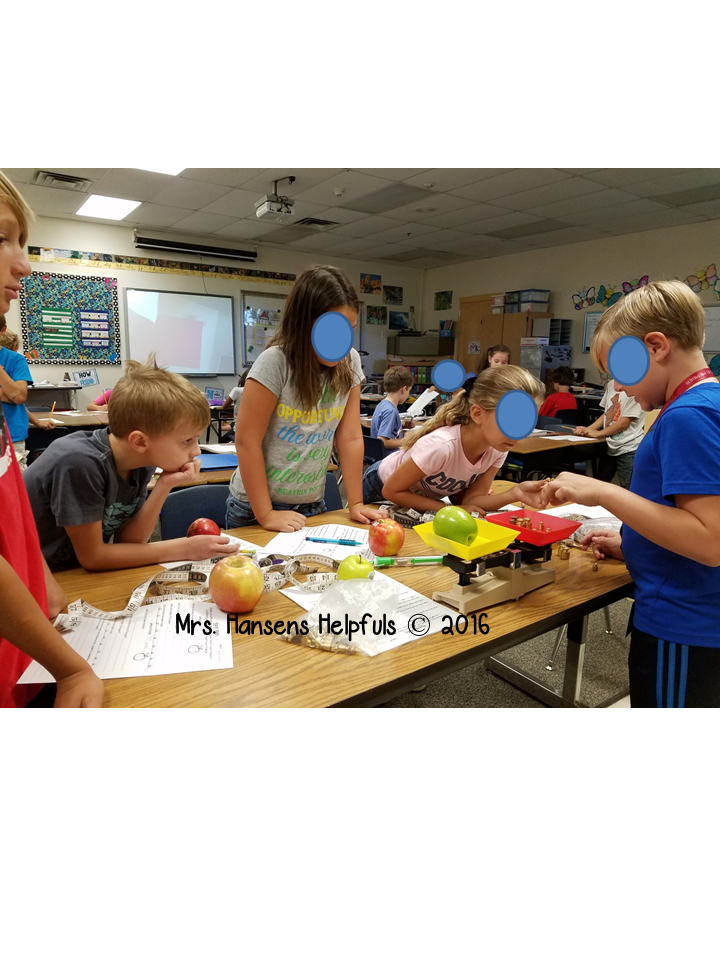
Math tie-in: Students measure different apple types with measuring tapes, spring scales, and a balance. (This I did as a teacher led center). Pic below.
Science tie-in: Students conducted
apple experiments to look for solutions to stop the oxidation process.
Overall, this theme has created a
lot of motivation, learning, and great writing results.
For the first two days I have
decided to post the product as a FREEBIE for FOLLOWERS, as a thank you!
Enjoy!
Erin
Monday, July 18, 2016
Esperanza Rising by Pam Munoz Ryan
Hi All!
One of the
books that over the years I felt has made an impact on understanding differing
cultures and immigrant struggles includes Esperanza Rising by Pam Munoz Ryan.
I have read this book several times and
even created a reader’s theater play to accompany the book and literature unit.
This book
is about a young girl named Esperanza who grows up a wealthy child living on
her family farm in Mexico. When unexpectedly her father is killed, leaving the
mother in a difficult position. She must either marry her cruel brother-in-law
or sneak away. Esperanza and her mother
chose to flee to America leaving the grandmother behind to follow later. The
book follows Esperanza through many difficulties and shows how she matures,
including how she starts to understand the enormity of her new life situation.
The main ideas students can take
away are:
1.
A drastic character change
from the beginning of the story until the end. Showing how Esperanza goes from
being a girl of privilege to a migrant worker.
2.
It demonstrates the struggles
immigrant workers face when coming to America and how people slave to make
pennies.
3.
Introduces what striking on a
picket line is and what Esperanza felt like in the choice to cross or not cross
the picket line.
4.
It demonstrates to be proud
of who you are no matter your life situation and more.
Overall, I wholeheartedly recommend
this book. I feel it is best suited for grades 4 through 6 where students can pick
up on the more difficult concepts.
Thanks!
Erin Hansen
Wednesday, July 6, 2016
Integrating Character Traits
Hi All!
Something that I have been working
on since last year has been integrating character trait lessons throughout the
year.
By doing this it has improved
student learning by:
1.
Increase the learning of new
vocabulary
2.
Looking at book characters in
a different way
3.
Making connections between
character traits and their motivations throughout the book
4.
Applying character traits to
their own created stories and analyzing other stories to see if they can
recognize the traits
5.
Discovering their own
character traits
After teaching the basic lessons
about character traits to students, I had students implement it into their
writing. I did this by giving students
2-3 character trait cards.
| Character Card Example |
| Character Card Example |
Depending on the student’s challenge
level, depended on the cards I gave them. For example, a student that struggles
might have received the cards, friendly
and stubborn (basic character
traits). A student that needs a bit more of a challenge would receive the cards,
obstinate and ridiculous (more thought provoking character traits). Another
difficult challenge is to give students opposite traits such as selfish and generous.
Students take their cards and have
to create a story with a main character that holds ALL trait cards that were
given. I also give students a graphic organizer to show the character traits
and how they will or were represented in the story. This makes them accountable to plan out the
story and integrate the character traits.
Here is an example of Harry Potter:
I hope this is an idea you can apply
to your own classroom. I truly believe it benefited my students in their
reading and writing.
I do have a character trait card PDF
Presentation and Card/Activities product. If you are interested please click on
this link: Character Traits.
Thanks!
Erin Hansen
Saturday, July 2, 2016
All About Me Poster and Activities FREEBIES
Hi Everyone,
I just added a new freebie for my
shop. It is for the beginning of the year and is All About Me Posters and
activities. Here is a quick peak. If you
like it, please consider following my shop for more freebies and great products to come!
All About Me Poster Freebies link - then just click on my free download button.
Thanks,
Erin
Tuesday, June 28, 2016
Race the Wild: Rain Forest Relay
Hi All!
Race the Wild: Rain Forest Relay is the first in the Kristin Earhart ecosystem series. I love
that it has several facts about the ecosystem and explains how they interact.
This is a great read for students in
grades 2 - 4. A brief overview for this book: This books starts off a race
through different ecosystems. This leg of the race occurs in the Amazon Rain
Forest, where along the way the reader will learn many different facts about
plants, animals, and other ecosystem parts (in this case about the Amazon
River). The story is focused around the Red team and its four members, Sage,
Dev, Russell, and Mari.
The main ideas students can take
away are:
1.
Interaction of different
parts of the rain forest.
2.
There are 4 main levels of
the rain forest.
3.
Wildlife facts about thing
such as the poison dart frog, squirrel cuckoo, capybara, three-toed sloth,
piranha, Amazon River dolphin, and more.
4.
Another aspect of the life
supported by the sacred kapok tree. (I think a teacher could even tie in an
additional book, The Great Kapok Tree, for additional lessons or
comparisons about the rain forest. I thought this was a good connection for my
classroom).
I created a literature unit that accompanies
this story. In it I included text evidence based comprehension questions,
character trait evidence, fact journal, expository writing, and more.
These are some pics from the unit.
If you are interested please click on this link: Race the Wild: Rain Forest Relay.
Thanks!
Erin Hansen
Monday, June 27, 2016
I Survived the Sinking of the Titanic, 1912
Hi All!
I Survived the Sinking of the
Titanic, 1912 is the second in the series that I
have read. I enjoyed the book and still love that Lauren Tarshis brings out the
history subtly to younger readers. However, I will say I enjoyed I Survived the
Battle of Gettysburg, 1863 much more.
This was an appropriate and fun book
for my third graders. A brief summary for this book is that it follows the
story of an adventurous 10 year old boy named George who is traveling with his
Aunt Daisy and his sister Phoebe. They are traveling first-class on the Titanic
when it struck an iceberg. During, the story George interacts with the staff
and third-class passengers which gives the reader different perspectives of the
different classes.
The main ideas students can take
away are:
1.
Differing perspectives from
wait staff, third-class passengers, first-class passengers, and the differences
between men and women + children on the fateful voyage.
2.
Demonstrates different class
systems had differing privileges.
3.
History of the Carpathia
coming to the rescue, too late and the nonchalant attitude of first-class
passengers when the boat first hit the iceberg. In addition to third-class
passengers being locked below deck.
4.
The struggle of different
individuals trying to make it onto a lifeboat and how this struggle led to a
change in a law for passenger ships.
5.
The change of a relationship
between a boy and his father.
I created a literature unit that accompanies
this story. In it I included text evidence based comprehension questions,
character trait evidence, change in relationship, expository writing debate,
and more.
These are some pics from the unit.
If you are interested please click on this link. I Survived the Sinking of the Titanic, 1912
Thanks!
Erin Hansen
Subscribe to:
Posts (Atom)